
Ask any Gen X woman about asking for help and she’ll tell you — it’s practically a crime, punishable by guilt, worry, and a side of “not good enough.”
Our mouths are quick to write checks our butts can’t cash. The overdraft fees are burnout, resentment, and carrying everyone else’s emotional luggage.
Not a surprise when we were raised on an antiperspirant slogan chirping, “Never let them see you sweat.”
As I learned in my burnout recovery journey, this “not asking for help” thing we do becomes an identity marker. Proof of competence, control, and worth… until it becomes self-destructive.
The first step to feeling lighter? Offload what was never yours to carry with The Mental Load Detox.
Why Gen X Women Can’t Ask for Help
Gen X women were raised in the “just figure it out” era, which turned us into self-sufficient adults, rewarded for our silent coping skills and solution-oriented mindset.
Many of our resumes begin with saving our parents from the blinking 12:00 on the VCR and microwaves.
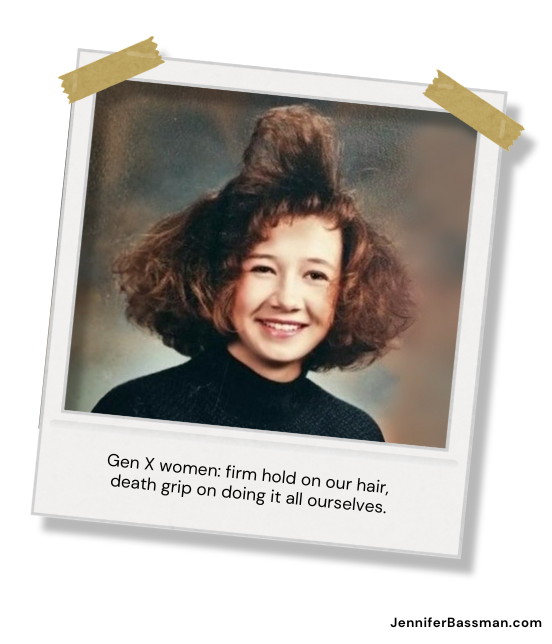
As latchkey kids who came home to empty houses, there was no one to ask for help. We got used to solving our own problems. That self-sufficiency became our badge of honor, proof of competence and control.
This marker of self-sufficiency became an important piece of our identity, defining our worth. Not only because we feared losing our freedom if we couldn’t manage our own problems, but we realized it gave us more control over our own lives without parental interference.
Who didn’t feel like a badass running a household and commanding an army of siblings and neighborhood kids at the age of 12?
Your Biological Response When You Don’t Ask for Help
What the people around us don’t see is the panic and stress that comes with “just figuring things out.” It’s a mixture of self-doubt and pride that fuels the negative self-talk keeping us in this refusal loop. As well as a way to avoid another reason to feel guilty.
We have spent our entire lives thinking this is normal and part of maintaining control over our lives.
What’s really going on under the hood: when you refuse to ask for help, your brain doesn’t see independence, it sees threat.
Each “I’ll just handle it” moment lights up your stress response system like a pinball machine. Cortisol and adrenaline flood in, keeping your body in a constant state of hypervigilance — the same mode it uses for emergencies, not emails or permission slips.
Over time, that chronic activation rewires your nervous system.
Your baseline becomes alert and exhausted at the same time. It’s a twisted cocktail of anxiety, irritability, and fatigue.
Translation? Your body thinks you’re saving the tribe from saber-toothed danger when you’re really just saving everyone from their own calendar chaos or blinking VCR clocks. The result: burnout masquerading as competence.
Asking for Help Isn’t Weakness
Asking for help isn’t a weakness.
There. I said it. Now, you say it back.
As silly as it seems, you need to continue to repeat this until you believe it enough to follow through. This builds that pathway in your mind so that it becomes a natural, comfortable response.
Getting help from others allows you to manage your stress because it doesn’t tick off your nervous system. Think of it as nervous system regulation.
Every time you say no, delegate, or say “I can’t do this alone”, your body actually interprets that as safety.
Your stress hormones ease up, your prefrontal cortex (the rational, problem-solving part of your brain) comes back online, and you stop running on pure adrenaline.
The biggest news: the world doesn’t implode, no one dies, and other people “just figure things out” too.
Letting others step in is how your brain learns that rest isn’t dangerous and that it’s a positive influence.
Sure, it will feel uncomfortable at first, because your nervous system thinks chronic stress is normal. But every time you ask for help and survive it, you rewire that belief.
This is how self-reliance turns into self-respect.